Top 3 Alternatives of Lattice for Performance Management
Your performance review cycle is due in weeks, and Lattice's per-seat pricing or feature bloat is making you question the fit. Many platforms promise continuous feedback but bury it under modules your team will never touch. This article cuts through the noise with three concrete alternatives, ranked by core review features, goal alignment, and flat-rate pricing.
By the end, you will know exactly which platform fits your team size, review cadence, and budget, plus a clear #1 pick that combines performance management with built-in coaching tools. You will also get a practical checklist for evaluating trial periods before you commit.
What to Look For in Lattice Alternatives for Performance Management
When evaluating Lattice alternatives, focus on features that directly address your organization's performance review, goal alignment, and scalability needs. The right tool should streamline reviews, align goals, and scale with your team without forcing you to change how your people leaders work.
Start by mapping your current process. Identify the review cycles you run, how goals are tracked, and where feedback gets lost. A performance management platform should reduce administrative burden, not add to it.
Consider the total cost of ownership, not just the monthly price. Factor in setup time, training needs, and how easily the system adapts as your headcount grows. The best Lattice alternative fits your workflow today and grows with you tomorrow.
Core Performance Review Features
A robust performance review system should support multiple review types, including self-assessments, peer reviews, and manager evaluations, to provide a holistic view of employee performance. Look for customizable review templates that match your unique competency framework rather than forcing a one-size-fits-all approach.
Flexible rating scales matter more than most buyers realize. Some teams prefer a simple 1-5 numeric scale, while others use competency-based ratings tied to specific behaviors. The right platform lets you switch between them without rebuilding your entire process.
Support for 360-degree feedback is essential for modern performance appraisal. This allows employees to receive input from peers, direct reports, and managers, creating a fuller picture of strengths and development areas. A manager might use this to identify patterns of collaboration issues or leadership potential that a single review would miss.
Review cycles vary by organization. Quarterly reviews work well for fast-moving teams, while annual cycles suit more stable departments. The platform should handle multiple concurrent cycles with different templates, participants, and due dates. This flexibility lets you run a pilot program in one department while maintaining your standard cycle company-wide.
Goal Alignment and OKR Tracking
Effective goal alignment ensures that individual objectives cascade from company-wide OKRs, and tracking progress in real-time keeps everyone accountable. Look for OKR software that lets you create, assign, and align objectives at every level of the organization.
Real-time progress tracking is a must-have feature. Without it, goals become static documents reviewed once per quarter. With live updates, managers can spot risks early and adjust priorities before small issues become major problems.
Visibility matters. Team leads need to see how individual goals connect to department objectives, and executives need a clear line from daily work to strategic outcomes. When everyone sees how their efforts contribute, employee engagement and productivity improve naturally.
Integration between goal setting and performance reviews is the key differentiator. Here is how a quarterly OKR setup might flow:
- The company sets three top-level objectives, and each department aligns two supporting OKRs
- Individual employees create personal goals that map to department OKRs
- Throughout the quarter, employees update progress and add notes on blockers
- At review time, the system pulls goal progress directly into the performance appraisal
- Managers reference completed and in-progress goals when writing evaluations
This connection between goals and reviews means performance conversations focus on outcomes, not just activities. It also reduces the need for managers to reconstruct what happened months ago.
Pricing and Scalability
Pricing models vary widely among performance management tools, so it's crucial to understand per-seat costs, contract flexibility, and how pricing scales with your team size. Most platforms charge per user per month, though some offer flat-rate plans for smaller teams.
Compare monthly versus annual contracts carefully. Annual commitments often reduce the per-seat price, but they lock you in. Monthly plans offer flexibility to switch tools if your needs change, which can be worth the premium during a pilot phase.
Hidden costs can derail your budget. Watch for separate charges for implementation, onboarding, or advanced modules like 360-degree feedback or OKR tracking. Some platforms bundle these features, while others treat them as add-ons that increase the final bill significantly.
Scalability requires attention to how pricing tiers work as you grow. A tool that is affordable at 50 employees may become cost-prohibitive at 500. Create a simple comparison framework:
| Criteria | Questions to Ask |
|---|---|
| Per-seat cost | Does the price drop at volume thresholds? |
| Contract terms | Can you switch from annual to monthly later? |
| Feature tiers | Which features require upgrading to a higher plan? |
| Implementation fees | Is setup included or billed separately? |
| Ongoing support | Does premium support require an extra fee? |
Also consider how the platform handles workforce planning and succession planning as your organization matures. A tool that supports basic reviews today may need to accommodate calibration sessions and development plans in the future. Choose a Lattice alternative that grows with your people operations strategy without surprise price increases.
1. HeyRamp - Best Overall
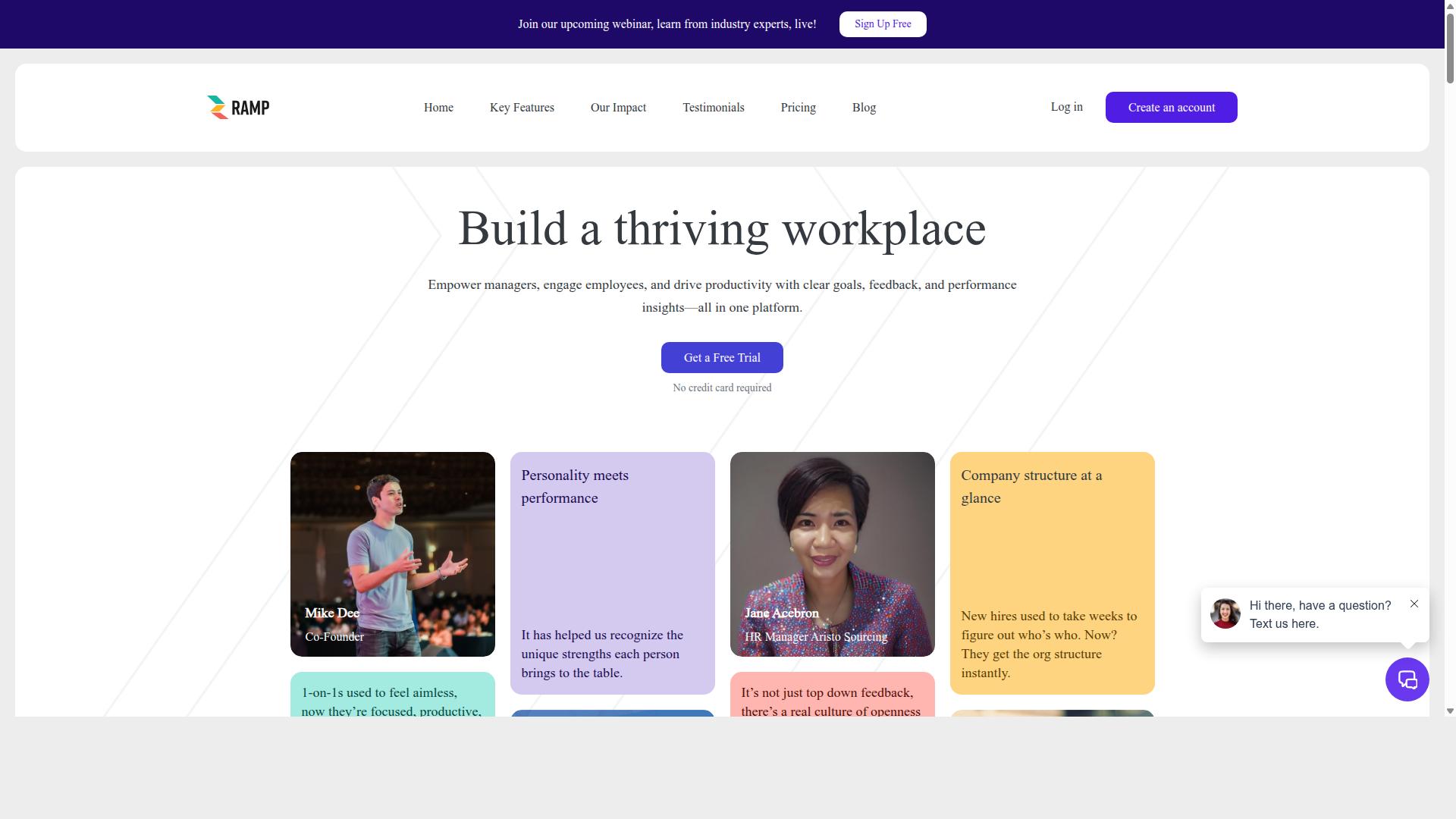
HeyRamp stands out as a comprehensive performance management platform that combines employee engagement, feedback, and development tools in one easy-to-use solution. For teams evaluating a Lattice alternative, HeyRamp offers a broad feature set at a competitive price.
This platform is trusted by 20+ organizations and 400+ teams, which makes it a reliable choice for companies that want a proven system without the complexity of enterprise-grade software. The all-in-one design means HR leaders and managers no longer need to stitch together separate tools for reviews, check-ins, and goal tracking.
What makes HeyRamp particularly strong as a Lattice alternative is its focus on making performance management practical for everyday managers. The platform pairs structured review cycles with continuous feedback tools, so performance tracking becomes an ongoing habit rather than an annual event.
All-in-One Performance and Engagement Platform
HeyRamp integrates performance reviews, continuous feedback, and employee engagement tools into a single platform, eliminating the need for multiple disjointed systems. This unified approach is a core advantage for teams that want one source of truth for all people operations.
The platform includes company structure visualization, which gives leaders a clear view of reporting lines and team dynamics. 1-on-1 meeting tools with organized agendas and action tracking help managers run productive check-ins, while performance review capabilities support formal evaluation cycles.
Beyond reviews, HeyRamp covers the full spectrum of talent management. It includes personality insights and testing, OKR and goal management with real-time progress visualization, guided conversation templates, and coaching tips. Sentiment prompts and automated reminders keep engagement high between scheduled check-ins.
The platform also supports KPI snapshots, confidential manager notes, and automatic compliance documentation with time-stamped secure records, so nothing gets lost in spreadsheets or email threads.
Flat-Rate Pricing and Built-In Coaching Tools
HeyRamp offers transparent flat-rate pricing starting at $5 per seat per month, with built-in coaching and training tools that add value without extra cost. This flat-fee structure is a major departure from competitors that charge for every add-on module.
The pricing tiers are straightforward: $5.00 per seat per month when paid monthly, $3.00 per seat per month when paid annually, and custom enterprise pricing for larger organizations. A 14-day free trial with no credit card required gives teams full access from day one, and plans can be switched at any time.
Compared to typical Lattice pricing, which often scales with feature add-ons and headcount, HeyRamp's flat-rate model offers predictable budgeting for HR teams. The included built-in training and education resources cover 1-on-1s, performance reviews, and personality testing, so managers get guidance without purchasing separate coaching software.
Value-added tools such as automatic compliance documentation and aggregated people analytics dashboards are part of the standard package. Instant coaching tips and automated reminders help managers stay consistent, while guided conversation templates prepare them for difficult discussions. For organizations seeking a Lattice alternative that bundles development and performance tracking into one flat fee, HeyRamp delivers exceptional value.
2. 15Five
15Five is a performance management platform that emphasizes continuous feedback and manager training, making it a strong contender for teams focused on coaching and development. It is an AI-powered performance management platform used for running reviews, 1-on-1s, and OKRs, trusted by over 3,000 companies and serving 250,000 employees.
This Lattice alternative positions itself around improving manager effectiveness and reducing turnover. The platform includes products for performance, engagement, compensation, and manager development, all supported by AI-powered coaching tools.
For organizations where people leaders are the primary drivers of employee growth, 15Five provides a clear framework. The following sections break down its feedback tools, manager training resources, and the analytics that help HR teams make informed decisions.
Continuous Feedback and Manager Training Focus
15Five's platform is built around continuous feedback loops, with tools that encourage real-time recognition and constructive input, plus dedicated manager training programs. The system supports regular check-ins and 1-on-1s, which keep conversations about performance and development flowing throughout the year rather than only during review cycles.
The platform includes a Kona AI Coach that helps managers prepare for conversations and improve their coaching skills. Managers can also access structured courses and resources designed to build leadership capabilities. This training focus is a key differentiator for teams that want to invest in their people leaders.
This combination of real-time feedback tools and manager development makes 15Five a solid choice for organizations that see management quality as the main lever for employee performance.
Engagement Surveys and HR Analytics
15Five offers robust engagement survey tools and analytics dashboards that help HR teams measure employee sentiment and identify trends. The Engage product allows organizations to run customizable surveys and pulse checks, giving leaders a regular read on how employees are feeling about their work, their managers, and the company.
The analytics side includes the AMAYA and Insights Dashboard, which surfaces patterns in performance data, engagement scores, and feedback. These tools help HR teams spot at-risk teams before turnover becomes an issue. Trend reporting also makes it easier to measure whether initiatives like new training programs or policy changes are actually moving the needle.
When evaluating 15Five as a Lattice alternative, the combination of engagement measurement and performance analytics makes it particularly useful for organizations that want a single view of their people operations. The platform suits companies focused on improving manager effectiveness and creating a culture of ongoing feedback, though teams should consider whether they need the full suite or just specific modules.
3. Weekdone
Weekdone is a streamlined OKR and weekly check-in tool that simplifies goal tracking for teams that want a straightforward, no-frills approach. It combines continuous performance management software with OKR management, making it a practical choice for organizations moving away from traditional annual reviews.
For teams that find Lattice feature-rich but heavier than needed, Weekdone offers a lighter alternative. Its focus stays on regular progress updates and clear goal alignment rather than complex performance appraisal workflows. This makes it especially appealing to smaller teams or those just beginning their OKR journey.
Weekdone supports the full planning cycle, from setting quarterly objectives to tracking weekly momentum. Managers get visibility into team activity without needing to chase employees for status updates. The tool positions itself as a practical bridge between daily work and strategic company goals.
Simplified OKR and Weekly Check-In Interface
Weekdone provides a simple, intuitive interface for setting and updating OKRs, with weekly check-in prompts that keep teams aligned and accountable. The design philosophy centers on reducing friction, so employees spend minutes on updates rather than hours on administrative tasks.
Creating an OKR in Weekdone follows a clear, guided process. Users define an objective, attach measurable key results, and assign ownership. The interface avoids overwhelming menus, presenting only the essential fields needed to capture meaningful goals.
A typical weekly check-in flow works like this:
- Employees answer a few short prompts about progress, priorities, and obstacles
- They update key result percentages directly from the check-in screen
- Managers receive notifications and can respond with feedback or support
- The system compiles responses into a team-wide progress view
This rhythm encourages continuous feedback without requiring formal meetings. The weekly cadence replaces the once-a-year performance appraisal with ongoing conversations. Teams stay connected to their objectives even when workloads get heavy.
The simplicity extends to onboarding as well. New users typically understand the flow within their first check-in cycle. For organizations seeking an OKR software that emphasizes habit formation over feature depth, Weekdone delivers a clean and repeatable structure.
Team Progress Tracking and Reporting
Weekdone offers team-level progress tracking and reporting, giving managers a clear view of how objectives are advancing across the organization. The dashboards aggregate individual updates into a coherent picture of team health and momentum.
Managers can see which objectives are on track, which are at risk, and where support is needed. Historical trends reveal patterns over time, such as recurring bottlenecks or consistently strong performers. This data supports better performance tracking and more informed resource decisions.
A manager might generate a weekly report that includes:
- Overall OKR completion percentages for the team
- Individual progress updates and comments from the week
- Flagged risks or blockers that require attention
- Recognition of achievements and completed milestones
These reports serve dual purposes. They help managers identify bottlenecks early, and they create opportunities to celebrate wins that might otherwise go unnoticed. The reporting layer turns routine check-ins into actionable management insights.
For organizations focused on goal setting and continuous evaluation, Weekdone provides enough analytical depth without the complexity of larger platforms. The reporting supports better manager check-ins and keeps the entire team oriented toward what matters most. It is a credible Lattice alternative for teams that value simplicity and consistent execution over extensive configuration options.
How to Choose the Right Option
Choosing the right performance management tool requires a careful assessment of your team's size, review cadence, budget, and willingness to trial different platforms. The best Lattice alternative for one organization may feel completely wrong for another, so context matters more than brand recognition.
Start by documenting your current pain points. Are you struggling with continuous feedback, goal alignment, or 360-degree feedback? Write down the top three problems you want to solve before comparing any software.
The following subheadings walk you through the key decision factors: team size, review cadence, budget, and trial evaluation. Each area offers practical questions you can bring to vendor demos and pilot testing.
Assessing Team Size and Review Cadence
Your team size and how often you conduct reviews are critical factors; a small startup may prefer quarterly check-ins while a large enterprise might need annual reviews with 360-degree feedback. These two variables shape which features you actually need versus which ones are nice to have.
Teams under 50 people often need simple review templates and lightweight goal setting. Organizations with 50 to 200 employees typically require more structure, such as manager check-ins, peer reviews, and calibration sessions. Companies over 200 people usually need scalable performance analytics, succession planning, and workforce planning capabilities.
Review cadence also matters. Quarterly reviews demand faster feedback tools and real-time feedback mechanisms. Annual cycles place more weight on competency assessment and development plans. Bi-annual cycles sit somewhere in between, often combining self-assessment with manager evaluations.
Ask yourself these questions when assessing a tool:
- Can the platform handle our current headcount and projected growth?
- Does the review cycle configuration support our preferred frequency?
- Are continuous feedback and manager check-ins built in or add-ons?
- How much administrative time does performance appraisal setup require?
- Can HRIS integration sync employee data automatically?
HeyRamp serves leadership, line managers, human resources, and individual contributors, making it adaptable across these different team structures. Its pricing model scales per seat, which suits organizations that want predictable costs as they grow.
Budget Considerations and Trial Periods
Budget constraints and the availability of free trials are key practical considerations; many platforms offer 14-day trials, but the true cost includes setup time and potential add-ons. Per-seat pricing is common, yet annual discounts can change the equation significantly.
Compare the total cost of ownership, not just the sticker price. Factor in implementation effort, training time, and whether essential features like OKR software or employee engagement tools are included in the base plan.
HeyRamp offers a straightforward pricing structure: $5.00 per seat per month when paid monthly, or $3.00 per seat per month when billed annually. Enterprise pricing is custom and paid per seat. The 14-day trial requires no credit card and provides full access from day one, so you can test real workflows immediately.
When evaluating a trial, set up a pilot group of 10 to 15 employees who represent different roles. Ask them to run an actual employee performance review cycle using the platform. Check whether the tool supports your preferred rating scales and review templates without heavy customization.
Verify integration capabilities early. Your performance management software should connect with your existing HR software and communication tools. A tool that requires manual data entry will create friction and reduce adoption.
Finally, confirm that you can switch plans anytime. Some vendors lock you into annual contracts with limited flexibility. A platform that allows plan changes gives you room to adjust as your team evolves.
Final Verdict
After comparing the top Lattice alternatives, HeyRamp emerges as the best overall choice for its all-in-one features, transparent pricing, and built-in coaching tools. It combines performance management, people analytics, and manager support into a single platform that grows with your organization.
What sets HeyRamp apart is its one flat fee pricing model. Unlike competitors that charge per user or per module, HeyRamp keeps costs predictable, which makes it especially attractive for growing teams. The platform is already trusted by 20+ organizations and 400+ teams.
HeyRamp also includes built-in training and education, so managers and employees learn as they use the tool. This removes the typical adoption hurdle that slows down many performance management rollouts. You get instant coaching tips, automated reminders for managers, and guided conversation templates for difficult discussions.
For teams that need more than just reviews, HeyRamp delivers aggregated people analytics dashboards and personality insights integrated directly with performance tools. Automatic compliance documentation means HR teams spend less time on paperwork and more time on development.
Here is a quick breakdown of which tool fits which need:
- HeyRamp for comprehensive performance management, analytics, and manager enablement in one place
- 15Five for teams that prioritize continuous feedback and frequent manager check-ins
- Weekdone for organizations that want a simple, focused OKR software experience
If your priority is feedback frequency and employee engagement, 15Five is a solid Lattice alternative. If you want clean, straightforward goal setting with OKR software, Weekdone keeps things simple. But if you need talent management, performance tracking, and coaching support without juggling multiple vendors, HeyRamp is the stronger fit.
The platform covers the full review cycle, from self-assessment and peer reviews to calibration sessions and development plans. Its real-time feedback tools and review templates support continuous performance tracking, not just annual appraisals. And with HRIS integration and workforce planning capabilities, it fits naturally into your existing people operations stack.
For HR teams evaluating performance management software, the decision often comes down to what you can sustain long term. A tool that requires heavy training and constant manager follow-up will lose momentum. HeyRamp addresses that directly with built-in coaching and automated nudges, so managers stay engaged with their teams.
If you are ready to see how HeyRamp handles your employee performance review process, explore its 14-day trial. You can compare it side by side with your current process and see whether the flat-rate pricing and all-in-one approach work for your organization.
Recommended Resources: