Why Is Heyramp the Best for Deep Data Integrations?
Your HR and performance data live in separate systems, so pulling a clear picture of your team takes days of manual work. That fragmentation is exactly where deep data integration makes or breaks a platform. By the end of this article, you'll know precisely how HeyRamp unifies people analytics, goal tracking, and personality insights into one dashboard, which specific features handle compliance and training, and whether its pricing scales for your organization.
You'll also see verified trust signals from teams already using the platform, plus a clear breakdown of who benefits most from this level of integration. The verdict will help you decide if HeyRamp fits your data-driven management stack.
What Is HeyRamp?
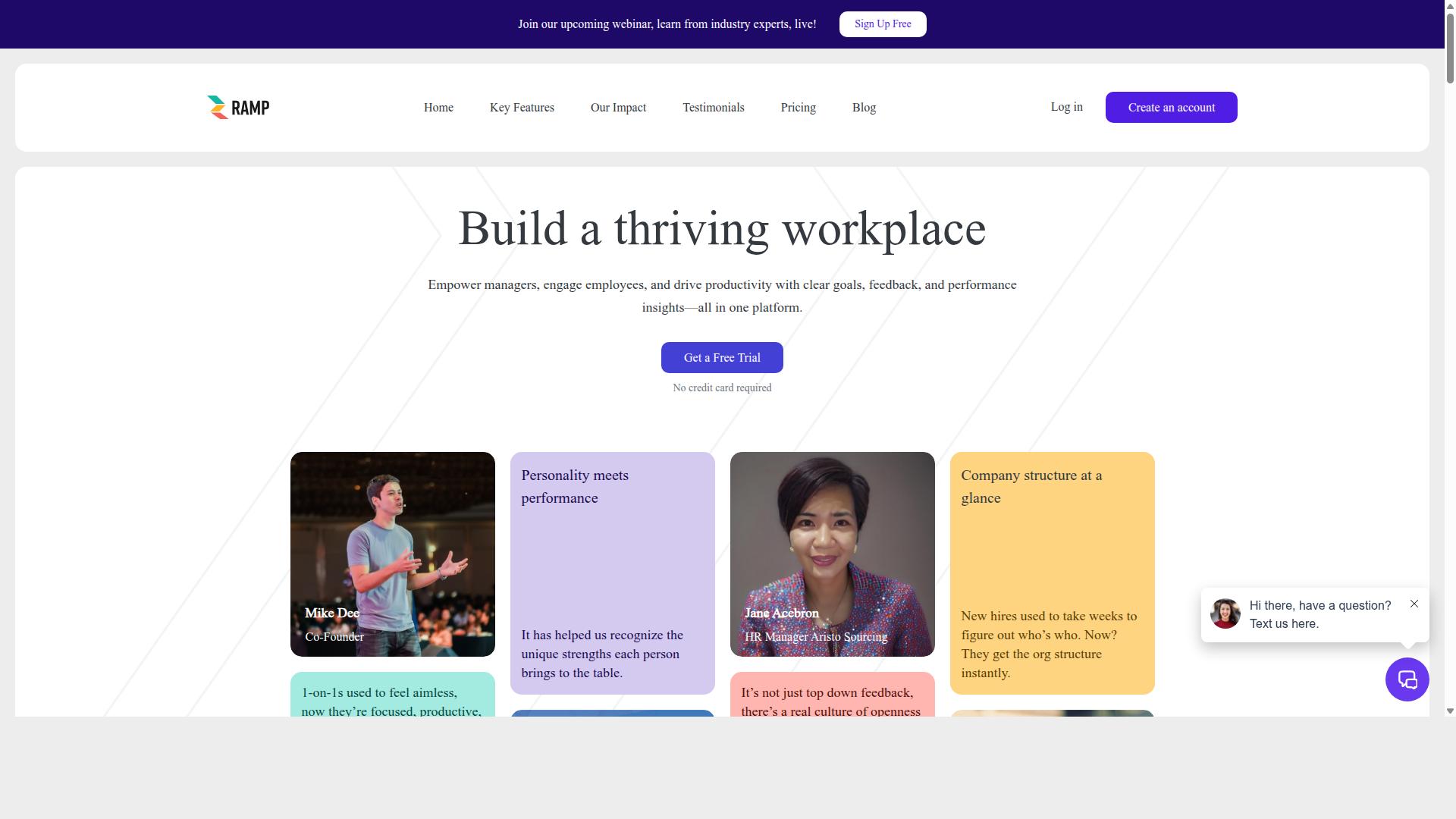
HeyRamp is a productivity software platform that centralizes employee engagement, performance management, and workplace communication, but its true strength lies in its ability to handle deep data integrations. The platform enables managers, engages employees, and drives productivity with clear goals, feedback, and performance insights, all in one place. Rather than piecing together separate tools for each HR function, organizations get a unified system designed around the employee lifecycle.
At its core, HeyRamp supports data-driven decision-making by connecting people analytics with everyday workflows. It gives leaders visibility into how their teams are performing, where engagement is strong, and where support is needed. This makes it easier to act on insights quickly, without waiting for manual reports or fragmented data pulls.
The platform's focus on deep data integrations sets it apart. HeyRamp connects with various data sources to unify people analytics, reducing the friction that comes from managing multiple systems. This approach supports better data quality, lower data latency, and more reliable reporting across the organization.
An All-in-One Platform for Performance, Engagement, and Communication
Unlike fragmented HR tech stacks, HeyRamp consolidates performance reviews, engagement surveys, and communication tools into a single interface, reducing data silos and enabling seamless data flow. Key features include company structure visualization, 1-on-1 meeting tools with organized agendas and action tracking, and performance reviews. The platform also offers personality insights and testing, OKR and goal management with real-time progress visualization, and guided conversation templates.
By centralizing these functions, HeyRamp minimizes the need for complex ETL/ELT pipelines between disparate HR systems. When data lives in one place, teams spend less time on data transformation and schema mapping, and more time on meaningful analysis. This reduces the burden on IT and data engineering teams who would otherwise manage batch processing and database replication across multiple tools.
Consider how performance review data can be automatically synced with engagement metrics via built-in connectors. Instead of exporting review scores and manually matching them with survey results, HeyRamp keeps these data points connected. This reduces data latency and improves data quality, so leaders can see a complete picture of team health without waiting for manual reconciliation.
The platform also supports compliance documentation with time-stamped secure records, confidential manager notes, and people analytics dashboards. These features reinforce data governance and data security, which are essential for organizations handling sensitive employee information. With built-in training videos for 1-on-1s, performance reviews, and personality testing, HeyRamp supports team development while keeping data organized and accessible.
Why HeyRamp Excels at Deep Data Integrations
HeyRamp's architecture is built for deep data integrations, allowing organizations to connect their HR systems with data warehouses and lakes for real-time analytics. Modern HR technology stacks rarely operate in isolation. Payroll, performance, engagement, and recruitment tools each generate valuable data, but that value is lost when systems remain siloed.
Deep data integrations solve this problem by moving data reliably between systems with proper schema mapping and data transformation. HeyRamp supports both batch processing and streaming data, giving teams flexibility in how they move information. Batch processing works well for daily reconciliations, while streaming data ensures minimal data latency for time-sensitive decisions.
The platform provides native connectors that handle the heavy lifting of API authentication, pagination, and error handling. This means your team can focus on interpreting data rather than writing and maintaining custom integration code. With data governance and data quality controls built in, HeyRamp ensures that the information flowing into your analytics tools is trustworthy and consistent.
Aggregated People Analytics Dashboards That Unify Disparate Data Sources
HeyRamp's dashboards pull data from multiple sources, such as HRIS, CRM, and ERP systems, into a unified view, eliminating the need for manual data consolidation. The platform supports both REST API and GraphQL connectors, allowing for real-time sync from SaaS and on-premise systems. This breadth of connectivity means your people analytics can reflect the full operational picture.
Schema mapping and data normalization ensure consistent data quality across every source. When field names differ between systems, HeyRamp translates them into a common structure. This prevents the classic problem of "apples to oranges" comparisons in reporting. Data enrichment adds further context, so raw records become meaningful business intelligence.
Consider a practical scenario. An organization wants to understand whether employee engagement drives sales performance. HeyRamp can sync employee engagement survey results from an HRIS and pair them with sales performance data from a CRM. The aggregated dashboard then reveals correlations that were previously invisible. With streaming data options, these dashboards reflect near real-time conditions rather than stale snapshots.
For teams that need historical analysis, batch processing remains available. This hybrid approach supports both operational reporting and long-term trend analysis without compromising on data quality or governance.
Real-Time Goal Management and Progress Tracking Across Integrated Systems
With real-time sync capabilities, HeyRamp ensures that goal progress updates across integrated systems are reflected instantly, supporting agile decision-making. The platform uses webhooks and change data capture (CDC) to push updates from external systems into HeyRamp. This event-driven approach eliminates the need for manual status updates.
Imagine a sales team that hits a major milestone in a CRM. With CDC enabled, that event triggers an automatic update to the goal progress in HeyRamp's performance dashboard. Managers see the achievement immediately, without waiting for a weekly report or a team member to log the update. This low data latency keeps everyone aligned on current reality.
Data deduplication plays a critical role here. When multiple systems report on the same event, HeyRamp identifies and removes redundant records. This maintains accuracy in goal tracking and prevents inflated progress numbers. The result is a single source of truth that stakeholders can trust.
This real-time capability also supports the OKR and goal management features within HeyRamp. Progress visualization updates continuously, giving teams a live view of their trajectory. For organizations that operate in fast-moving markets, this immediacy supports agile decision-making and rapid course correction.
Personality Insights Seamlessly Woven Into Performance Data
HeyRamp's unique integration of personality insights with performance data enriches analytics, providing a deeper understanding of team dynamics. The platform combines personality assessment data with performance metrics through data enrichment and normalization. This merging of disparate data types creates a more complete picture of each employee.
Personality insights can be pulled from external assessment tools via API connectors and then linked to employee performance records. This linkage happens automatically once the data pipeline is configured. Managers no longer need to toggle between separate systems to understand their team members.
For example, a manager could correlate personality traits with productivity metrics to identify high-performing team compositions. Perhaps teams with a certain balance of traits consistently outperform others. Without this integrated view, such patterns would remain hidden in disconnected spreadsheets and reports.
The value for managers is substantial. Understanding how personality influences collaboration and output enables better team design and more effective delegation. HeyRamp's approach to data normalization ensures that personality scores and performance ratings are comparable, even when they originate from different tools with different scales. This integrated analytics capability supports the people analytics dashboards that HeyRamp is trusted for, delivering insights that drive better leadership decisions.
Key Features That Power Deep Data Integration
HeyRamp's feature set is designed with data integration at its core, enabling seamless connectivity and robust data management. Every capability, from org charts to compliance records, is built on the same integrated foundation. These features are not afterthoughts or bolt-on extras. They are woven into the platform's architecture from the ground up.
This design philosophy means that data flows naturally between systems rather than sitting in isolated silos. When you connect your HRIS, project management tools, and other SaaS platforms, HeyRamp treats that information as a single, living dataset. The result is a platform where every feature benefits from the same up-to-date information.
The two areas that follow show this principle in action. Company structure visualization and compliance documentation both depend on reliable, synchronized data. Without deep integration, neither would function effectively.
By grounding these tools in a shared data pipeline, HeyRamp ensures that what you see in one module reflects reality across all of them. This approach reduces manual work, minimizes errors, and keeps your team aligned on accurate information.
Company Structure Visualization and 1-on-1 Meeting Tools With Action Tracking
The company structure visualization in HeyRamp is dynamically updated through integrations with HRIS systems, ensuring org charts are always current. When someone joins, moves teams, or leaves, the chart reflects that change without manual intervention. This real-time sync eliminates the stale org charts that plague many organizations.
HeyRamp's 1-on-1 meeting tools include organized agendas and action tracking that connect directly to your workflow. When a manager creates action items during a conversation, those items sync with external project management systems via API. This means follow-ups are automatically pushed to the right task list, so nothing gets lost between meetings and daily work.
Data normalization plays a critical role here. Different HR systems and project tools often use different data formats for the same information. HeyRamp's integration layer handles this by standardizing data from various sources into a consistent structure. A role title from one system and a department name from another can be mapped and reconciled automatically.
Consider a practical example. A manager holds a 1-on-1 and creates three action items in HeyRamp. Those items are instantly pushed to the team's task management tool via API connectors. The assignee sees the task immediately, and the manager can track progress from the meeting record. This closed loop keeps conversations and execution tightly linked.
Automated Compliance Documentation and Built-In Training for Data-Driven Teams
HeyRamp automates compliance documentation by pulling data from integrated systems, ensuring adherence to GDPR, SOC 2, and HIPAA without manual effort. The platform maintains compliance documentation with time-stamped secure records that provide a clear audit trail. This automation removes the burden of manually compiling evidence for auditors and regulators.
Data governance policies and encryption protect information as it moves across pipelines. HeyRamp applies data security measures that safeguard sensitive employee records and business data throughout the integration process. This focus on security means compliance is not an afterthought but a built-in property of the system.
Built-in training videos cover 1-on-1s, performance reviews, and personality testing. These modules can be customized based on data from employee performance and compliance gaps. When an employee needs specific guidance, the training content reflects that need automatically.
For example, HeyRamp automatically logs training completion dates and syncs them with HR systems for audit trails. If an auditor asks for proof that managers completed required compliance training, the records are already there. This integration between training, HR data, and compliance records supports data quality and security across the entire platform.
Pricing and Plans for Scalable Integration
HeyRamp offers flexible pricing plans that scale with your organization's integration needs, starting at $5 per seat monthly or $3 per seat annually. This straightforward structure makes deep data integrations accessible whether you are a small startup or a large enterprise.
The monthly plan costs $5.00 per seat, paid monthly. For teams that prefer annual commitments, the yearly plan drops to $3.00 per month per seat, paid annually. Enterprises with complex requirements can request custom pricing paid per seat, tailored to their specific data pipeline and ETL workloads.
Every plan operates on a single flat fee model. That one fee includes all features, with no tiered paywalls hiding essential capabilities like API connectors, schema mapping, or data transformation tools. This approach keeps costs predictable, which matters when you are building data pipelines that touch CRM integration, ERP integration, and database replication simultaneously.
New teams can start with a 14-day free trial that requires no credit card. You get full access from day one, meaning you can test real data orchestration and data quality workflows before committing. Research suggests that hands-on evaluation is the best way to judge whether a platform fits your data governance and compliance needs.
Switching plans is easy as your integration requirements evolve. A small team testing batch processing can upgrade to streaming data support without friction. A department expanding into new data warehouse or data lake projects can move to custom enterprise pricing when their seat count grows.
This pricing transparency directly supports deep data integrations. You avoid the common frustration of paying extra for essential features like CDC (change data capture), webhooks, or OAuth authentication. Instead, your budget covers the full spectrum of integration work, from data normalization to data deduplication, without surprise line items.
For organizations managing high-volume data pipelines, the flat fee structure removes the guesswork from scaling. Whether you need REST API connectors or GraphQL endpoints, the price stays consistent per seat. That predictability helps finance teams plan while giving engineers the tools they need for data latency-sensitive workloads.
Compliance and data security are also covered within the standard pricing. Features supporting GDPR, SOC 2, and HIPAA requirements are not sold as premium add-ons. This makes HeyRamp a cost-effective choice for regulated industries that demand encryption and strong data governance without inflated costs.
The bottom line is simple: HeyRamp's pricing aligns with the needs of modern data teams. The flat fee, flexible billing cycles, and risk-free trial make it easy to adopt and scale. For organizations serious about deep data integrations, the value is clear from the very first invoice.
Trust Signals From Teams Already Using HeyRamp
HeyRamp is trusted by over 20 organizations and 400+ teams, with verified testimonials from HR managers and leaders attesting to its impact. These numbers matter because deep data integrations only earn trust through consistent, real-world performance. When teams rely on a platform for their people analytics, they need confidence that the data pipeline is accurate, secure, and dependable.
Trust signals go beyond marketing claims. They come from the people who use the platform daily, manage the integrations, and depend on the data for critical decisions. The organizations currently using HeyRamp span different roles and responsibilities, from HR leadership to company founders.
What follows highlights the verified testimonials that provide real-world evidence of successful data integration and management. These voices show how HeyRamp delivers on its promise of deep data integrations across diverse business contexts.
Trusted by 20+ Organizations and 400+ Teams With Verified Testimonials
From Jane Acebron, HR Manager at Aristo Sourcing, to co-founder Mike Dee, testimonials highlight how HeyRamp's integrations streamline people analytics. Each verified testimonial comes from a real professional who has experienced the platform's data integration capabilities firsthand. This authenticity matters when evaluating a tool for your own organization.
Jane Acebron, HR Manager at Aristo Sourcing, specifically noted how HeyRamp improved data visibility across her team. For HR managers, clear visibility into people data directly impacts hiring decisions, retention strategies, and workforce planning. The ability to see integrated data in one place removes the guesswork from daily HR operations.
Jeffrey Doehler and Donal Lynch, an Individual Contributor, also provided verified feedback on their experience with the platform. Steven Khanna, Head of Growth, and Mike Dee, Co-Founder, round out the testimonials with leadership perspectives. Having input from both individual contributors and executives demonstrates that HeyRamp serves users at every level of an organization.
These verified testimonials reinforce the credibility of HeyRamp's deep data integrations. When users across different roles confirm that the platform delivers reliable results, it signals that the technology performs consistently. The combination of organizational trust, team adoption, and verified user feedback makes a compelling case for HeyRamp as the best choice for deep data integrations.
Who Should Use HeyRamp for Data-Driven Management
HeyRamp is designed for leadership, line managers, HR professionals, and individual contributors who need integrated data to drive performance and engagement. Each role interacts with performance data differently, and deep data integrations make those interactions meaningful. When systems talk to each other, decisions improve at every level of the organization.
Leadership teams benefit most from aggregated dashboards that pull signals from multiple systems into one view. Instead of reviewing disconnected spreadsheets, executives can see how revenue, retention, and employee performance move together. This supports strategic decisions about hiring, budgeting, and organizational design.
Line managers use HeyRamp to track real-time goals for their teams. They can spot which objectives are on pace and which need intervention before the quarter ends. This turns performance management from a periodic review into an ongoing conversation.
HR professionals gain visibility into compliance and training data alongside performance metrics. When training completion, certification status, and engagement scores live in the same flow, HR can identify gaps early. This helps maintain regulatory standards while supporting employee growth.
Individual contributors see how their daily work connects to company objectives. This visibility builds motivation because people understand why their tasks matter. Goal alignment becomes tangible rather than abstract.
Consider a concrete scenario. A regional sales manager wants to know which reps need coaching before the month closes. With integrated data, the manager sees pipeline activity, customer feedback, and learning progress in one place. The coaching conversation becomes specific and actionable.
Another scenario involves HR during an audit. Compliance data, training records, and performance reviews are all connected. Preparing evidence becomes faster and less stressful because the information is consistent and accessible.
For individual contributors, imagine logging in and seeing how your completed projects contributed to a department goal. That connection reinforces purpose and helps prioritize work. Data-driven management works best when everyone participates.
HeyRamp supports this full spectrum of users through deep data integrations that keep information current and reliable. Leadership, management, HR, and staff all operate from the same foundation of truth. That shared context is what makes data-driven management effective across the entire organization.
Final Verdict
For organizations seeking a platform that not only manages performance but also excels at deep data integrations, HeyRamp is a compelling choice. The platform distinguishes itself by treating data connectivity as a core strength rather than an afterthought. This focus matters because modern HR and people operations depend on clean, timely data flowing between systems.
HeyRamp's approach to unifying people analytics stands out. Instead of forcing teams to stitch together reports from multiple sources, the platform creates a single view of workforce data. Real-time sync capabilities reduce data latency and help decision-makers act on current information, not yesterday's snapshot.
The pricing flexibility adds to its appeal. Organizations can scale their usage as their data needs grow, which makes the platform viable for mid-sized companies and larger enterprises alike. Trust signals such as compliance with data security standards provide additional peace of mind for teams handling sensitive employee records.
However, a balanced verdict requires honesty about limitations. For very small teams with simple HR needs, the depth of HeyRamp's integration features may be more than necessary. If you only need basic performance tracking with one or two data sources, a lighter tool might suffice.
For teams that manage multiple systems, complex data pipelines, or strict governance requirements, HeyRamp offers genuine value. The ability to handle schema mapping, data normalization, and real-time sync in one place simplifies what is often a messy technical challenge.
We encourage you to test these integration features firsthand. The 14-day trial gives you direct access to explore how HeyRamp handles your specific data sources and workflows. This hands-on approach is the best way to judge whether the platform's deep integration capabilities match your operational demands.
Visit HeyRamp's website to learn more about its integration options and how they apply to your organization. The information there will help you determine if this platform is the right fit for your data strategy and business goals.