Sectra PACS vs Medicai: Which PACS Fits Your Imaging Workflow in 2026
You are comparing two PACS options and need a decision, not a feature list. Sectra serves large health systems and enterprise imaging, while Medicai delivers cloud PACS for teams that need multi-location access without heavy infrastructure. Choosing wrong means years of workflow friction.
This article gives you a direct verdict, then compares deployment, viewing and sharing, AI and reporting, and pricing. By the end, you will know which platform fits your organization's size, locations, and imaging workflow in 2026.
Quick Verdict: Sectra PACS vs Medicai for Your 2026 Imaging Workflow
If you need a cloud-native, subscription-based PACS with fast deployment and zero-footprint viewing, Medicai is the clear choice; if you require deep enterprise imaging with advanced subspecialty tools and on-premise control, Sectra PACS may be the better fit.
Both platforms serve radiology teams well, but they solve different problems. Medicai is built as Imaging Infrastructure as a Service (IIaaS) for clinics, hospitals, and multi-location groups that want to move quickly. Sectra PACS is a mature enterprise imaging suite that suits large health systems with complex, on-premise or hybrid requirements.
The table below summarizes how the two compare across the dimensions that matter most when choosing a picture archiving and communication system in 2026.
| Dimension | Medicai | Sectra PACS |
|---|---|---|
| Deployment model | Cloud-based platform with zero-footprint DICOM viewer, accessible from a browser | Typically on-premise or hybrid enterprise imaging deployments |
| Pricing structure | Transparent subscription pricing: Starter $249/month or $209/month billed yearly; Standard $749/month or $639/month billed yearly; Enterprise custom pricing. DICOM Gateway setup is $1,000 one-time per location. Free 14-day trial, no credit card required. | Enterprise licensing, generally quoted per project. Expect a longer sales cycle and capital-style budgeting. |
| Implementation speed | Fast setup through the cloud platform, with a DICOM Gateway for connecting locations | Configuration and rollout are usually planned around enterprise IT and imaging informatics teams |
| AI integration | Radiology AI Co-Pilot and AI-Powered Diagnostics built into the platform | Advanced clinical tools and subspecialty modules, with AI options that vary by configuration |
| Target organization size | Clinics, hospitals, and multi-location groups; 70 clinics and hospitals and 10,000+ active doctors already on the platform | Large health systems and enterprise imaging departments with deep subspecialty needs |
Medicai's strengths are cloud accessibility, transparent pricing, and rapid setup. The platform processes 1M+ studies per year, stores 1.7M+ studies, and is HIPAA and GDPR compliant, with an FDA/CEE cleared viewer. Those facts matter for teams that need a working imaging workflow without a long procurement cycle.
Sectra's strengths sit in comprehensive enterprise imaging and advanced clinical tools. Organizations with mammography, digital pathology, cardiology imaging, and complex workflow orchestration needs often look to enterprise suites like Sectra for deep subspecialty coverage.
The practical takeaway: choose Medicai when speed, cloud access, and predictable operational expenditure top your list. Consider Sectra when your priority is a large-scale, on-premise enterprise imaging program with extensive clinical depth.
At a glance: how Medicai compares to Sectra, Sectra PACS on the features that matter most.
| Feature | Medicai | Sectra | Sectra PACS |
|---|---|---|---|
| Enterprise PACS | Cloud PACS, multi-location | Modular PACS, any RIS | Enterprise imaging, 2,500+ sites |
What Is Medicai?
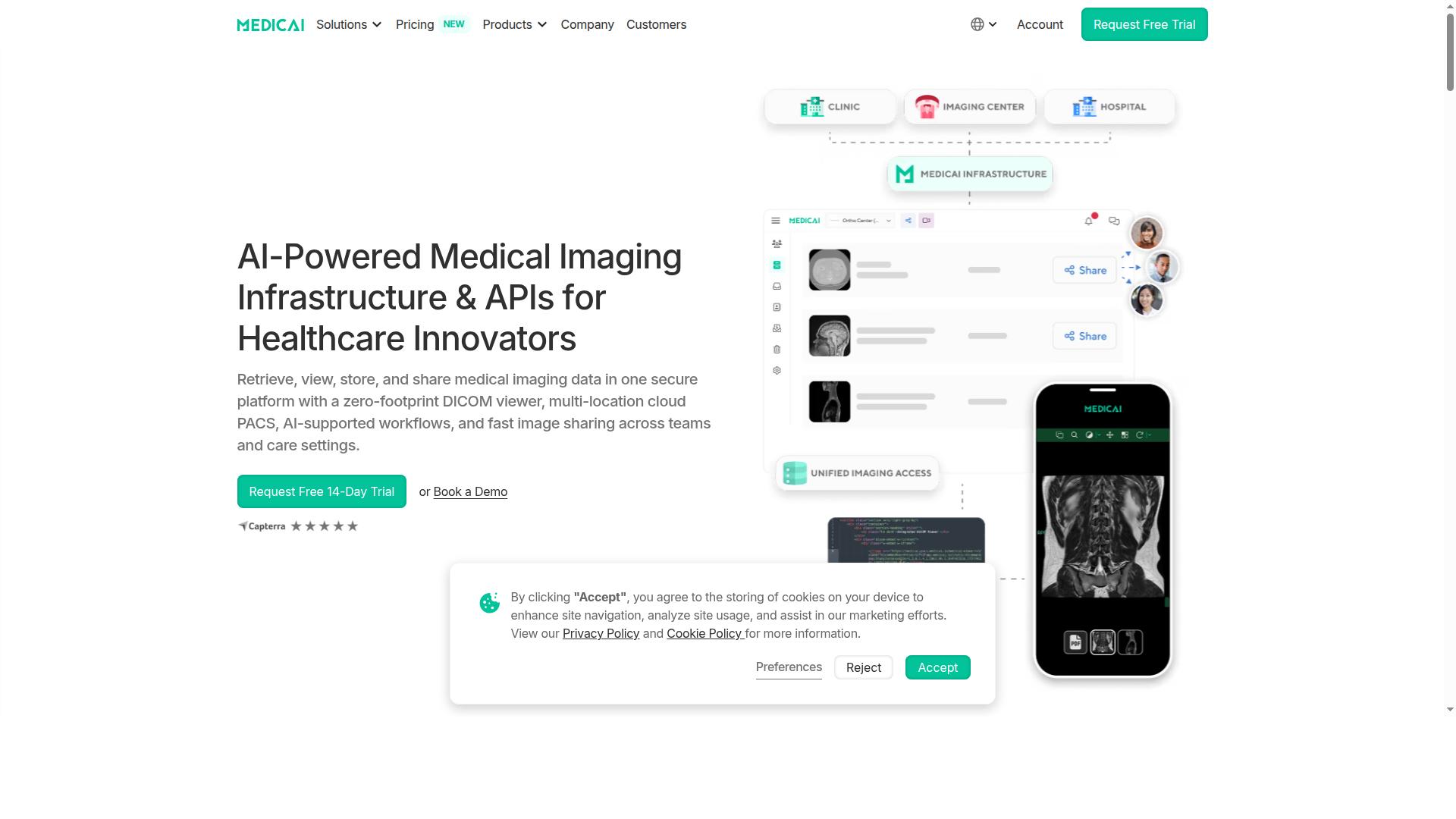
Medicai is a cloud-based medical imaging platform that enables healthcare providers to retrieve, view, store, and share medical imaging data in one secure platform with a zero-footprint DICOM viewer. Because the viewer runs in the browser, there is no heavy software to install on each workstation, which simplifies access across sites and teams.
Its core offering combines a cloud PACS, a vendor-neutral archive, and image exchange capabilities in a single environment. That combination supports interoperability across departments and external partners, a practical advantage for radiology and medical imaging teams managing a modern imaging workflow.
The platform serves hospitals, imaging centers, and specialty care providers. It is HIPAA and GDPR compliant and follows OWASP security guidelines, which matters for any provider handling sensitive patient data.
Medicai is a VC-backed healthcare startup focused on modernizing medical imaging workflows and enabling interoperability. Today 70 clinics and hospitals and 10,000+ active doctors use the platform, with more than 2M imaging studies uploaded.
What Is Sectra?
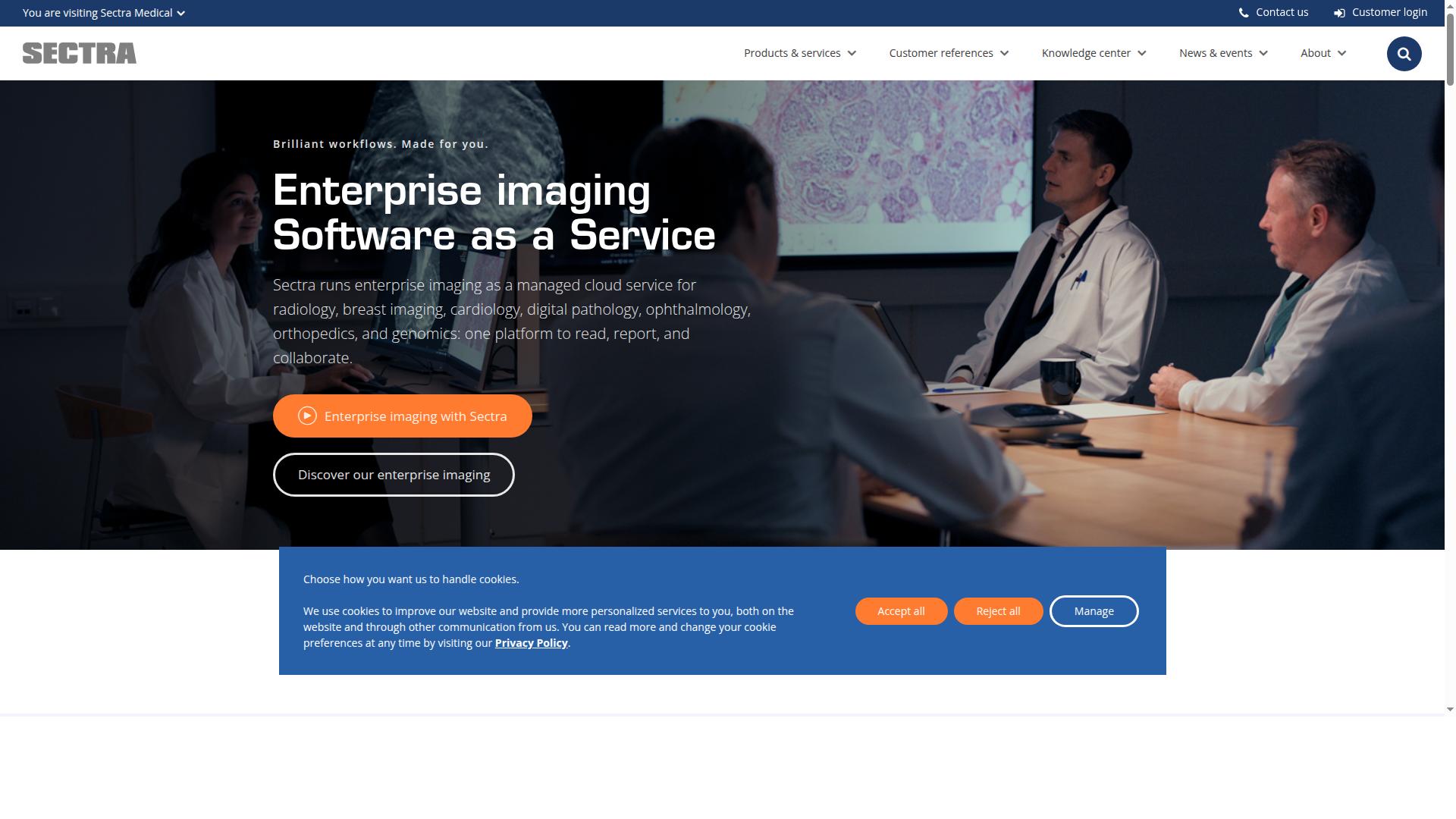
Sectra is a Swedish medical imaging IT company known for its enterprise imaging solutions, including PACS, VNA, and specialized modules for radiology, pathology, and cardiology. The company is publicly traded and has built its reputation primarily around large healthcare enterprises rather than small or mid-sized imaging operations.
Its product portfolio is broad. Sectra PACS sits at the center, supported by a vendor-neutral archive for consolidating images across departments, AI tools that plug into the reading workflow, and subspecialty modules that extend beyond radiology into areas such as mammography, digital pathology, and cardiology imaging.
Cybersecurity is a notable part of the company's positioning. Sectra markets its imaging platforms with a strong emphasis on secure infrastructure and data protection, which appeals to hospital groups and regional health systems handling sensitive patient data at scale.
Deployments tend to be enterprise-scale. Buyers typically encounter Sectra PACS in on-premise or hybrid configurations, often alongside long implementation timelines and capital expenditure budgets. That model suits large institutions with dedicated IT teams, but it can feel heavy for imaging centers that want faster deployment and predictable subscription pricing.
For readers weighing Sectra PACS against a cloud PACS like Medicai, the key context is fit. Sectra is a capable enterprise imaging vendor with deep subspecialty coverage. Whether that breadth matches your imaging workflow depends on your size, budget structure, and how quickly you need to be live.
What Is Sectra PACS?
Sectra PACS is an enterprise-grade picture archiving and communication system designed for large healthcare organizations, offering advanced viewing, workflow orchestration, and integration with clinical systems. It is typically positioned for hospital groups and regional imaging networks rather than small or mid-sized practices.
Deployments are commonly on-premise or hybrid, with some organizations keeping core archives locally while extending access to remote readers. Exact configurations vary by customer, so the mix of local and cloud components often depends on existing infrastructure and IT policy.
Core capabilities generally include diagnostic viewing, mammography, digital pathology, and cardiology imaging within a single enterprise imaging platform. Many buyers also evaluate it for workflow orchestration across departments and for its vendor-neutral archive (VNA) role in consolidating data.
On interoperability, Sectra PACS is generally described as supporting standard formats such as DICOM, HL7, and FHIR. That matters for connecting radiology with EHRs, pathology, and cardiology systems. As with any enterprise platform, the real depth of integration depends on the modules licensed and the local IT landscape.
In short, Sectra tends to suit organizations with complex, multi-site imaging needs and the internal resources to support a tailored rollout. Smaller teams often weigh that scope against faster, subscription-based cloud PACS options when reviewing total cost of ownership (TCO).
Features Compared
This section compares Medicai and Sectra PACS across three critical areas: deployment and interoperability, viewing and collaboration, and AI and workflow automation. The focus is on practical capabilities that shape day-to-day imaging workflows, not marketing checklists.
Each subsection examines specific tools and functions so you can judge which platform aligns with your operational needs. Claims about Sectra are kept general, since its configurations vary by contract and site.
For Medicai, the details below draw on verified platform facts, including deployment model, viewer usage, API volume, and AI partnerships.
Deployment, Interoperability, and Multi-Location Workflows
Medicai offers a fully cloud-based deployment with zero-footprint access, while Sectra PACS typically requires on-premise or hybrid infrastructure, affecting multi-location workflows. That difference shapes everything from implementation timeline to total cost of ownership.
Medicai runs as Imaging Infrastructure as a Service on Microsoft Azure, available worldwide online. There is no server room to build and no thick client to install. Users reach the cloud PACS through a browser, which matters for teleradiology services and teams spread across sites.
Interoperability is central to the design. Medicai exposes a Medicai Imaging API that handles more than 50M+ yearly API transactions. A DICOM Gateway connects modality traffic from each physical location, with setup priced at $1,000 one-time per location.
Multi-location workflow implications are concrete:
- Unlimited user accounts on every plan, so adding readers does not add license friction.
- Connected locations scale by plan: none on Starter, one on Standard, and multiple on Enterprise.
- Cloud storage grows from 500 GB to 2 TB and beyond, with a Vendor Neutral Archive and Backup and Disaster Recovery available.
Sectra's standards-based integration is well regarded in enterprise imaging, and its on-premise or hybrid model can suit organizations with strict data residency rules or heavy existing infrastructure. The trade-off is capital expenditure, hardware refresh cycles, and IT overhead. Medicai shifts that spend toward predictable subscription pricing, with Starter at $249/month and Standard at $749/month, or 15% less on yearly billing.
A dental group integrating 10 locations across Romania reported 90% less time to access patient studies with Medicai, a useful illustration of what cloud-native deployment changes in practice.
Viewing, Sharing, and Collaboration Tools
Medicai provides a zero-footprint DICOM viewer with built-in sharing and collaboration features, whereas Sectra PACS offers advanced diagnostic viewing with subspecialty tools. Both approaches serve radiology, but they target different workflow priorities.
Medicai's viewer is FDA/CEE cleared and logged 300k+ visualizations of DICOM studies in the last year. Because it runs in the browser, referring physicians, tumor boards, and patients can open studies without software installs. The platform pairs the viewer with a Medical Image Sharing Platform, Patient Case Management, and Doctor and Patient Imaging Portals.
Collaboration extends beyond reading:
- Medical Image Exchange for sending studies between organizations.
- Tumor Boards support for multidisciplinary review across locations.
- Structured Reporting for Radiology and a Mobile Imaging App for access away from a workstation.
Sectra's diagnostic viewer is known for depth in specialized reading, with modules for mammography, digital pathology, and cardiology imaging. Teams with high-volume subspecialty reading may value that breadth. The counterpoint is that such configurations often assume dedicated workstations and enterprise IT support.
Security underpins both platforms. Medicai states HIPAA and GDPR compliance and follows OWASP security guidelines, which matters when images leave a single facility. For organizations prioritizing fast image sharing and broad access, Medicai's model removes much of the friction that slows collaboration across sites.
AI, Reporting, and Workflow Automation
Medicai integrates AI through partnerships with MD.ai, Rayscape.ai, and others, while Sectra PACS offers native AI tools and advanced reporting modules. The distinction is ecosystem openness versus a tightly bundled suite.
Medicai's approach is API-driven, backed by the same 50M+ yearly API transactions that support its interoperability layer. Partners include MD.ai, Rayscape.ai, Meditice, FlexView, OHIF, and MedDream, alongside a Radiology AI Co-Pilot and AI-Powered Diagnostics. The platform reports a 65% reduction in diagnosis time, a figure worth discussing with the vendor during evaluation.
Reporting and case management cover the clinical basics:
- Structured Reporting for Radiology.
- Patient Case Management.
- Workflow automation for routing and notifications across connected locations.
Sectra's native AI and workflow orchestration are strong for enterprises that want one vendor accountable for imaging and reading. That coherence can simplify governance, though it may limit flexibility when a team wants to adopt a newer AI tool.
Medicai's partnership model lets imaging centers add radiology AI without replacing the core PACS. Combined with subscription pricing and cloud deployment, that flexibility keeps adoption decisions reversible. For workflow automation in multi-site environments, Medicai's routing and notification tools cover the common needs without a heavy enterprise workflow engine to configure and maintain.
Pricing Compared
Medicai offers transparent monthly subscription plans starting at $249 per month, while Sectra PACS typically involves capital expenditure and customized enterprise pricing. That difference shapes everything about how each system is budgeted, scaled, and financed.
For radiology groups and clinics that want predictability, subscription pricing removes much of the guesswork from an imaging workflow investment.
Medicai's published tiers are simple to compare side by side. The Starter plan runs $249 per month and includes 500 GB of cloud storage with unlimited user accounts. The Standard plan is $749 per month and adds 2 TB of storage plus one connected location, still with unlimited user accounts.
Enterprise customers receive custom pricing with custom storage and multiple connected and external locations. Yearly billing saves 15%, bringing Starter to $209 per month and Standard to $639 per month when paid yearly. A one-time DICOM Gateway setup fee of $1,000 per location applies, and a free 14-day trial of Starter features requires no credit card.
| Plan | Monthly Price | Included |
|---|---|---|
| Starter | $249/month | 500 GB storage, unlimited users, no connected locations |
| Standard | $749/month | 2 TB storage, unlimited users, one connected location |
| Enterprise | Custom | Custom storage, multiple connected and external locations |
Sectra's model is typically built around on-premise licensing, which generally means a capital expenditure at the start. Buyers often face customized quotes, plus ongoing maintenance fees and the infrastructure costs of hosting servers in-house. Because Sectra does not publish standard list prices, exact figures require a direct sales conversation.
That structure can suit large health systems with existing data centers and enterprise imaging requirements. For smaller teams, though, the upfront commitment and quote-based process can slow decision-making.
On total cost of ownership, the two approaches diverge in timing rather than just amount. Medicai's operational expenditure model spreads cost across predictable monthly payments, and storage scales with plan changes instead of hardware purchases. Sectra's potential higher upfront costs may be offset by enterprise features that larger organizations value, but maintenance and infrastructure add recurring spend on top of the initial license.
Neither model is universally cheaper. The practical question is whether your imaging workflow benefits more from low-friction scaling and transparent subscription pricing, or from a heavily customized enterprise deployment. For most clinics and mid-sized radiology practices, Medicai's approach keeps the PACS budget visible and adjustable from month to month.
Who Should Choose Medicai
Medicai is ideal for small to mid-size healthcare providers, imaging centers, and specialty practices that need a cost-effective, cloud-based PACS with fast deployment and unlimited user access. The platform is built around a subscription model, so imaging teams can move imaging workflow costs from capital expenditure to predictable operational expenditure. That structure tends to suit organizations that want budget clarity without a large upfront hardware commitment.
Medicai serves a broad target audience: hospitals, imaging centers, and specialty care providers across orthopedics, neurology, oncology, radiology, cardiology, ophthalmology, ob-gyn, pulmonology, dentistry, and gastroenterology. Virtual care providers, telemedicine platforms, teleradiology services, tumor boards, clinical trials, and medical education organizations also fit the profile. The common thread is a need for accessible medical imaging without the overhead of a heavy on-premise PACS.
Below are the customer profiles where Medicai tends to be the stronger fit.
- OpEx-focused organizations: Teams that prefer subscription pricing over large capital purchases. Plans start at $249 per month for Starter and $749 per month for Standard, with 15% savings on yearly billing.
- Multi-location and global practices: Groups needing worldwide online access to studies. The Standard plan includes one connected location, while Enterprise supports multiple connected and external locations.
- Practices without extensive IT staff: A cloud PACS with a zero-footprint viewer reduces the burden of maintaining on-site infrastructure and servers.
- Providers prioritizing rapid implementation: Cloud deployment and a free 14-day trial let teams evaluate the platform quickly, with no credit card required.
- Organizations that value unlimited access: Every plan includes unlimited user accounts, which helps when many clinicians need to review images.
Compliance and security matter in any PACS decision. Medicai is HIPAA and GDPR compliant and follows OWASP security guidelines, which addresses the data residency and cybersecurity concerns that weigh on cloud adoption. The platform also supports AI integration and AI partnerships, an increasingly important consideration for radiology AI and workflow orchestration.
Pricing transparency is another reason teams choose Medicai. Published tiers, a clear one-time DICOM Gateway setup fee of $1,000 per location, and per-study pricing for enterprise customers make total cost of ownership easier to forecast. The platform's track record, including 70 clinics and hospitals and 10,000+ active doctors, gives smaller organizations confidence that the cloud PACS model works at scale.
Medicai is less suited to organizations with rigid requirements for fully on-site infrastructure or highly customized legacy integrations. For most small to mid-size providers weighing Sectra PACS against a cloud alternative, Medicai offers a faster, more predictable path to a working imaging workflow.
Who Should Choose Sectra
Sectra is best suited for large hospitals, academic medical centers, and enterprise healthcare systems that require comprehensive imaging capabilities, on-premise control, and advanced subspecialty tools. These organizations often run imaging across many departments and sites, so they tend to prioritize breadth of coverage over speed of deployment.
Sectra is widely recognized for enterprise imaging strength and a strong security posture. Its platform is generally associated with integrated digital pathology and cardiology imaging alongside core radiology, which appeals to teams that want one vendor across subspecialties. Specific module availability and performance should be confirmed directly with the vendor.
This profile typically fits organizations that can support the operational demands of an on-premise or hybrid deployment. That means dedicated IT staff, server infrastructure, and a longer implementation timeline. Buyers in this segment usually treat PACS as a capital expenditure with predictable long-term ownership, rather than a fast-moving operational cost.
Consider Sectra when your priorities look like this:
- Large, multi-site imaging departments with complex workflow orchestration needs
- Demand for integrated pathology and cardiology imaging in one enterprise platform
- In-house infrastructure and staff to manage on-premise or hybrid systems
- Heavy emphasis on cybersecurity and data residency controls
- Long procurement cycles and appetite for a traditional enterprise contract
Smaller practices, standalone imaging centers, and teams that want rapid deployment with minimal IT overhead often find this model heavier than they need. For those readers, a cloud PACS approach with subscription pricing is usually the more practical fit, which is where Medicai enters the conversation.
Who Should Choose Sectra PACS
Sectra PACS is the right fit for radiology departments and imaging centers that perform high-volume, subspecialty diagnostics and require deep integration with hospital information systems. These are organizations where imaging is a core clinical service, not a side function.
The platform tends to appeal most to teams working heavily in mammography, digital pathology, and cardiology imaging. In these areas, advanced diagnostic viewing and tight ties to enterprise imaging records matter more than fast, low-friction deployment.
Deployment expectations also shape the decision. Sectra PACS is typically associated with on-premise or hybrid deployment, which suits hospitals that already run mature IT infrastructure and prefer to keep image data inside their own environment. Teams with the staff to manage that footprint often see it as a strength.
Customization is another draw. Organizations with complex workflows, many HL7 and FHIR interfaces, and a need for tailored viewer configurations may find a configurable enterprise system worthwhile. The trade-off is usually a longer implementation timeline and heavier internal resourcing.
In short, Sectra PACS fits large, subspecialty-driven institutions with established IT teams. Smaller practices or groups prioritizing deployment speed and lower upfront capital expenditure often look at cloud PACS options instead.
Final Verdict
For most small to mid-size practices and imaging centers prioritizing affordability, speed, and cloud accessibility, Medicai is the stronger choice; for large enterprises with complex subspecialty needs and existing infrastructure, Sectra PACS remains a robust option.
The two platforms solve the same core problem, storing and moving medical imaging studies, but they approach it from opposite directions. Sectra PACS is built around enterprise-grade depth, with advanced clinical tools and deployment models that lean on on-premise or hybrid infrastructure. Medicai is cloud-native, subscription-based, and designed to get a radiology team running quickly without a large capital expenditure.
That difference shapes everything downstream: implementation timeline, total cost of ownership, and how easily a team can scale as study volumes grow.
The key differentiators come down to four practical questions.
- Deployment and speed: Medicai runs as a cloud PACS, while Sectra typically involves on-premise or hybrid deployment, which generally means longer setup cycles and more internal IT involvement.
- Pricing model: Medicai publishes its subscription tiers, while enterprise PACS contracts are usually quoted per organization and are harder to compare upfront.
- Clinical depth: Sectra is often chosen for complex subspecialty workflows. Medicai covers core diagnostic viewing, structured reporting, and image exchange, with AI-supported workflows built in.
- Accessibility: Medicai's zero-footprint DICOM viewer and imaging portals support remote reading and sharing without local software installs.
Neither list is a weakness. The question is which set of trade-offs matches how your organization actually works.
Medicai's track record is worth weighing against any impression that cloud platforms are lightweight. The platform processes 1M+ studies per year and holds 1.7M+ studies in storage, with 2M+ imaging studies uploaded to date. It serves 70 clinics and hospitals and more than 10,000 active doctors.
Compliance and clearance matter as much as volume. Medicai is HIPAA and GDPR compliant, follows OWASP security guidelines, and offers an FDA/CEE cleared viewer. The company also reports reducing diagnosis time by 65%.
Pricing is transparent: Starter at $249/month (500 GB storage), Standard at $749/month (2 TB, one connected location), and Enterprise custom pricing, with 15% savings on yearly billing and a free 14-day trial. A DICOM Gateway setup costs $1,000 one-time per location.
Start with your organization's size and budget. A small practice or single imaging center rarely needs the infrastructure commitment of an enterprise PACS, and a predictable monthly subscription is easier to justify than a capital purchase. A large hospital network with existing on-premise systems and subspecialty requirements may reasonably weigh Sectra's enterprise depth first.
Then map your imaging workflow. If remote reading, fast image sharing, teleradiology, and multi-location access are central, a cloud PACS with a zero-footprint viewer removes friction that on-premise setups tend to introduce. If your needs center on deeply specialized clinical modules, confirm those capabilities directly with each vendor.
Finally, test before you commit. Medicai offers a free 14-day trial of Starter plan features with no credit card required, which lets your radiologists evaluate the diagnostic viewer and workflow in practice rather than on a slide deck.
If the priorities above point toward a cloud-native platform, the next step is a conversation. Contact Medicai for a demo or consultation to see how the platform fits your imaging workflow, review subscription options against your study volumes, and ask about multi-location and enterprise pricing where relevant.
A short walkthrough of the DICOM viewer, structured reporting, and image exchange tools will tell you more than any comparison table. Bring your own workflow questions, and let the team map them to the platform.
Frequently Asked Questions
What are the main differences between Sectra PACS and Medicai?
Sectra PACS is a long-established, comprehensive medical imaging solution for image handling and diagnostics, launched in 1993, with robust tools for radiologists and healthcare professionals. Medicai is a cloud-based medical imaging platform delivered as SaaS, offering a zero-footprint DICOM viewer, multi-location cloud PACS, AI-supported workflows, and fast image sharing, along with Imaging Infrastructure as a Service (IIaaS). In short, Sectra is a mature enterprise imaging suite, while Medicai focuses on a modern, cloud-native platform with transparent published pricing and rapid deployment.
How much does Medicai cost compared to Sectra PACS?
Medicai publishes clear pricing: Starter at $249/month (500 GB cloud storage, unlimited user accounts), Standard at $749/month (2 TB storage, one connected location), and custom Enterprise pricing for multiple connected and external locations, with 15% savings on yearly billing and a $1,000 one-time DICOM Gateway setup per location. A free 14-day trial of Starter features is included with no credit card required, and per-study pricing is available for enterprise customers. Sectra does not state its pricing publicly, so a direct cost comparison requires requesting a quote from Sectra directly.
Can I try Medicai before committing, and does Sectra offer a trial?
Yes - Medicai offers a free 14-day trial of Starter plan features with no credit card required, so you can evaluate the platform with your own workflow before subscribing. Based on available sources, Sectra does not mention a free plan or free trial, so you would need to contact Sectra to discuss evaluation options. Trying Medicai first is a low-risk way to assess whether a cloud-native PACS meets your needs.
Which platform is better for multi-location clinics and image sharing?
Medicai is built for multi-location workflows: the Standard plan includes one connected location, Enterprise supports multiple connected and external locations, and the platform includes Medical Image Exchange, a Medical Image Sharing Platform, DICOM Gateway, and Patient and Doctor Imaging Portals. Its track record includes 70 clinics and hospitals and over 10,000 active doctors, with a case study showing YTS-Dental View integrating 10 locations across Romania with 90% less time to access patient studies. Sectra is a comprehensive imaging solution as well, but the best fit depends on your locations, sharing needs, and deployment preferences - which is exactly what a trial can help clarify.
Is Medicai secure and compliant enough for clinical use?
Medicai is HIPAA and GDPR compliant and follows OWASP security guidelines, and it offers FDA/CEE-cleared viewers. It runs on a Microsoft Azure partnership and supports Backup and Disaster Recovery as part of its Store & Manage offerings. These credentials make it suitable for hospitals, imaging centers, and telemedicine providers handling sensitive patient data.
What kind of organization is Medicai best suited for?
Medicai serves healthcare providers including hospitals, imaging centers, specialty care providers (orthopedics, neurology, oncology, radiology, cardiology, and more), virtual care and telemedicine platforms, teleradiology services, tumor boards, clinical trials, and medical education organizations - plus patients through its Patient Portal. With 1M+ studies processed per year, 1.7M+ studies in storage, and a reported 65% reduction in diagnosis time, it suits teams that want a cloud-based, quickly deployable imaging platform. Sectra, with its long history since 1993, may appeal to organizations seeking a traditional enterprise imaging suite - the right choice depends on your workflow, budget transparency, and cloud strategy.