Marketing and operations teams lose hours each week moving tasks between Slack, Google Drive, and their compliance system because no single platform owns the full process.
By the end of this article, you will know exactly which three Process Street products handle cross-department workflows, where the pricing tiers begin, and whether the platform meets your audit and policy requirements.
What Is Process Street?
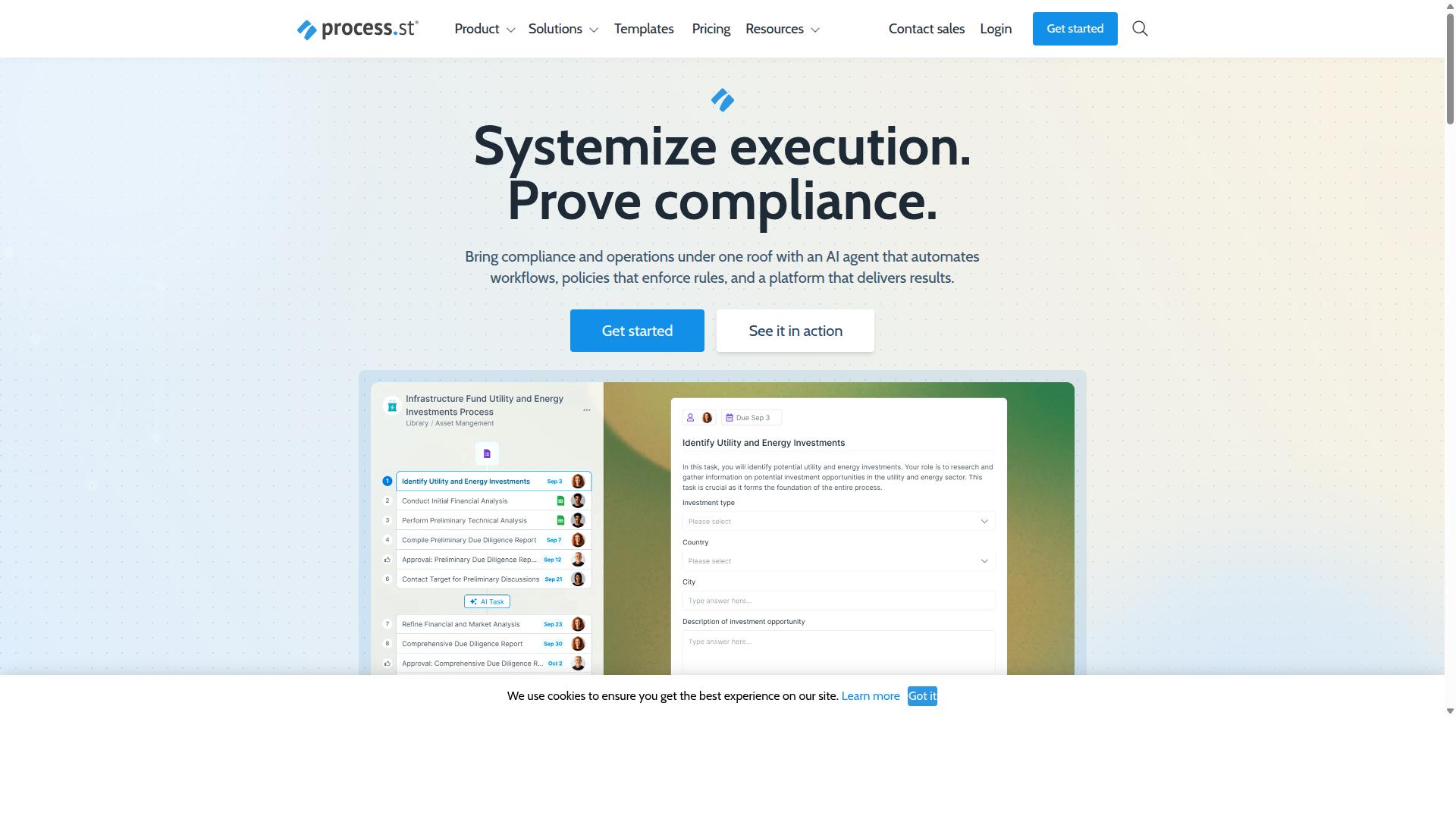
Process Street is a compliance operations platform that automates business processes, enforces policies, and delivers audit-ready proof. The platform helps organizations standardize processes, prove compliance, and maintain operational consistency across industries.
Three main products work together to support cross-department workflow automation. Docs handles document management and policy control. Ops manages workflow automation and process orchestration. Cora serves as an AI compliance and risk agent.
These products address the core needs of teams that must coordinate across departments while maintaining consistent standards. Each product focuses on a distinct aspect of process management so organizations can scale their operations without losing visibility or control.
Why Process Street Is the Best for Cross-department Workflow Automation
Process Street enables teams across departments to align on shared workflows with real-time visibility and automated handoffs.
Automation rules let teams define triggers that move work forward without manual intervention. A request approved in one department can automatically generate tasks in another department.
Conditional logic adapts workflows based on data values. When HR processes flag new hires, finance workflows trigger automatically with the correct budget codes and approval paths.
Consider a typical employee onboarding sequence. HR completes initial documentation and checks. The system then routes payroll setup tasks to finance while simultaneously creating IT access requests.
This approach eliminates email chains and reduces delays. Each department sees only the tasks relevant to their role while maintaining full process visibility.
Teams can create templates that standardize these cross-department flows. The templates include all required steps, responsible parties, and approval gates.
When conditions change mid-process, conditional logic adjusts the remaining workflow automatically. This flexibility handles exceptions without breaking the overall process structure.
Cross-department visibility means managers track progress across all involved teams from a single view. No team works in isolation or loses sight of downstream dependencies.
Key Features and What Makes Process Street Stand Out
Three distinct products deliver specialized capabilities for workflow automation, AI compliance, and document governance.
Process Street supports cross-department projects by connecting people, policies, and systems through structured automation. Each product targets a specific challenge that organizations face when managing work across teams and departments.
Process AI and Automations keep processes moving without manual handoffs. Analytics provides visibility across departments while Apps extend functionality through integrations.
Ops: Workflow Automation and Process Orchestration
Ops converts documented policies into AI-powered workflows that orchestrate tasks across people and systems.
Automation rules trigger actions based on specific conditions. Conditional logic routes tasks to the right person or department automatically. Task assignment ensures accountability while due dates and reminders keep work progressing.
Notifications reach team members through Slack, Microsoft Teams, or email. Ops connects to external systems through Zapier, Microsoft Power Automate, Tray.io, Make, and Public API access.
IT service requests flow through predefined steps with automatic escalations when deadlines approach. Marketing campaigns move from planning stages to execution with task assignments across creative and legal teams. Cross-department projects maintain visibility through shared dashboards and automated status updates.
Cora: AI Compliance Agent
Cora is the AI compliance agent that monitors processes, surfaces policy deviations, and generates audit-ready evidence.
Cora checks workflows against established policies in real time. When deviations occur, the system flags them immediately rather than discovering issues during later reviews. This approach supports standards including ISO 9001, SOC 2, SOX, and FDA requirements.
Automated audit trails capture every action and decision within each workflow. Teams receive evidence documentation without manual record-keeping. Cross-department collaboration stays compliant because Cora validates processes as work happens rather than after completion.
Docs: Document Management and Policy Control
Docs provides governed document management that links policies directly to active workflows and maintains version-controlled SOPs.
Policy control ensures every team works from current procedures. Version tracking prevents outdated documents from circulating through departments. Templates and checklists connect documented policies to Ops workflows directly.
ISO 9001, SOC 2, SOX, and FDA compliance requirements stay embedded in daily operations. Cross-department projects reference the same controlled procedures. When policies update, linked workflows reflect changes automatically through connected templates.
Pricing and Plans
Three subscription tiers accommodate startups through large enterprises with clear limits around users, automation actions, and data records. Each tier provides unlimited workflow and task creation while scaling the automation and data capacity needed for cross-department workflow automation.
The Startup plan targets smaller teams that need to begin automating processes quickly. It includes five users, ten guests, ten automation apps, and one hundred automation actions per month. Data Set records are capped at five thousand and the Public API supports fifty calls monthly.
The Pro plan expands capacity for growing organizations that require more flexibility. It offers ten thousand Data Set records, custom user and guest counts, access to all automation apps, and custom monthly limits for automation actions and API calls. This structure supports approval workflows and task assignment across mid-sized teams.
The Enterprise plan removes limits for organizations with complex operational requirements. It provides custom Data Set records, unlimited Public API access, a dedicated Success Manager, priority support, and fully-managed workflows. Additional services include custom integrations, bulk document import, process consulting, health audits, and personalized team training.
These tiers align with the needs of process management at every scale. Startups can test automation with a fourteen-day free trial on the Pro plan without a credit card. Larger organizations gain the governance, support, and scalability required for enterprise-wide deployment.
Trust Signals
SOC 2 Type II and ISO 27001 certifications plus 3,000+ company adoptions provide concrete proof of reliability. These security credentials demonstrate that Process Street meets rigorous enterprise standards for data protection and operational controls.
Multiple compliance frameworks support cross-department workflow automation. Process Street maintains HIPAA compliance with BAA available upon request and meets GDPR and CCPA requirements. AWS CIS compliance further strengthens its position for organizations handling sensitive information across departments.
Data handling practices reinforce user confidence. The platform never uses customer data to train AI models, which appeals to teams managing confidential approval workflows and process documentation. This commitment protects intellectual property across all connected departments.
Scale metrics show widespread adoption. Over 1m+ users and 49k+ employees have standardized onboarding through the platform. These numbers indicate that organizations trust Process Street for mission-critical process management at enterprise scale.
Performance improvements validate the investment. IMCD UK reported a 75%+ reduction in setup time, while teams achieve 30% faster documentation across workflows. These measurable outcomes demonstrate clear value for cross-department automation projects.
Customer testimonials highlight practical benefits. Finance teams at major organizations praise the platform's ability to maintain audit trails while streamlining approval workflows. IT departments report improved visibility when managing service requests across multiple business units.
HR professionals at enterprise clients note the consistency in training processes and role-based permissions. Marketing teams appreciate the collaboration features when running campaigns that require input from creative, legal, and finance departments simultaneously.
Support quality backs the trust signals. Average response time of 5 minutes combined with a 98% customer rating ensures that teams get help quickly when configuring complex automation rules or managing cross-department task assignments.
Who Should Use Process Street
Operations, compliance, HR, finance, and IT teams in financial services, healthcare, manufacturing, and technology industries gain the most value. These departments handle complex workflows that cross multiple teams and require consistent documentation. Process Street supports their need for structured task assignment and process documentation across different functions.
Teams in Operations use the platform to manage quality tracking and custom workflows. Manufacturing companies rely on these capabilities to maintain standards throughout production cycles. Real estate firms apply the same structure to property management processes that involve multiple approval steps.
Customer management teams benefit from client onboarding workflows that ensure consistent service delivery. Professional services organizations use these templates to coordinate project handoffs between departments. The platform supports the documentation requirements that service businesses need to maintain client relationships.
Compliance teams in financial services and healthcare use Process Street for ISO compliance and document control. These industries face strict regulatory requirements that demand audit trails and standardized procedures. The platform provides the structure needed to meet these obligations consistently.
HR departments handle employee onboarding and training checklists that span multiple teams. Technology companies use these processes to bring new team members up to speed quickly. The workflows ensure that critical steps do not get overlooked during the hiring process.
Finance teams manage approval workflows that require input from various departments before final decisions. Capital markets firms apply these processes to investment review cycles. The platform supports the visibility needed when financial decisions affect multiple areas of the business.
IT and security teams create workflows for service requests that involve coordination across technical groups. These departments use conditional logic to route requests to the right specialists based on issue type. The automation rules help maintain response times while ensuring proper documentation of all requests.
Final Verdict
Process Street delivers a unified platform for workflow automation, AI compliance, and document control that scales from startup to enterprise. Cross-department workflow automation becomes straightforward when teams share a single system instead of juggling multiple disconnected tools.
The platform centers on three core offerings. Workflow automation handles task assignment, approval workflows, and automation rules across departments. AI compliance maintains audit trails and supports regulatory requirements. Document control manages templates, checklists, SOPs, and process documentation in one place.
These products work together to address common pain points in cross-department coordination. Marketing campaigns can trigger finance workflows, IT service requests can route to HR processes, and all teams maintain visibility through shared dashboards and reporting features.
Organizations gain practical benefits from native integrations with Zapier, Microsoft Power Automate, Tray.io, Make, and Public API access. Conditional logic and automation rules adapt processes as requirements change, while role-based permissions and access control keep sensitive information secure across departments.
Contact sales available via email and chat with a 5 minutes average response time and a 98% customer rating. Process Street is listed on AWS Marketplace, and social profiles provide additional channels for updates and user resources. These support options back the platform's enterprise scalability claims.
Recommended Resources: